
Explore this essay
Six questions hiding inside one argument The technology clock and the human clock Owning the machine is different from using it The first damage may be to the ladder A bigger economy can still feel smaller at home South Korea asks a different version of the question The cloud has a plug Four futures, rather than one inevitable ending The ownership label does not tell you who answers the phone Why I would not budget around a government cheque The loops that make a direction hard to change War does not make the ownership problem simpler Super is the practical ownership route, with limits What would make me change my mind? The practical question at the next meetingOpen the Power Shift ExplorerThere is a very comfortable version of the AI story.
The technology gets better. We become more productive. The economy grows. Everyone benefits. Somewhere towards the end, somebody mentions abundance, and the presentation moves on before anyone asks who owns it.
I would quite like that version to be true.
I use these tools. I can see how much useful work they make possible. I am also capable of turning a modest research question into an evening involving economics, electricity infrastructure and the future of democratic government. Apparently I needed a hobby with fewer dependencies.
But the more I look at this, the less satisfied I am with the usual question: How powerful will AI become?
The question I keep coming back to is: what happens to our bargaining position when it does?
You can have better tools and less security. An economy can produce more while the people working in it struggle to pay the bills. A technology can become widely available while control of the things it depends on becomes more concentrated.
Those possibilities can coexist. That is the awkward bit.
This essay follows the research and scenario work I have been doing on AI, money and power, looking particularly at the US and Australia, with Europe and South Korea as useful comparisons. The near-term window is October 2026 to April 2028. Beyond that, I am more comfortable discussing possible structures than predicting a timetable.
There is, of course, every chance that parts of this will age like milk left in the sun. That is an occupational hazard of writing about the future. The useful response is to show the assumptions, distinguish observations from guesses, and say what would make me change my mind.
My working view is that AI capability is likely to spread faster than ownership of its most valuable foundations. Institutions will struggle to keep up. Meaningful gains may reach ordinary people, but a new, broad public claim on AI profits will require deliberate political and institutional work.
The technology does not do that part for us.
Six questions hiding inside one argument
The AI debate becomes much easier to follow when we stop trying to make one answer carry six different questions.
| Axis | The plain-English question | What I would watch |
|---|---|---|
| A1 · Capability velocity | How quickly can AI do more useful work, at an acceptable cost and standard? | Reliable task completion, cost per accepted result, the gap between demonstrations and deployment. |
| A2 · Absorption capacity | How quickly can organisations and society adapt? | Training, job redesign, education, regulation and the time needed to put them into practice. |
| A3 · Control of the productive base | Who controls the things the system cannot operate without? | Chips, electricity, cloud capacity, models, distribution channels and the ability to switch suppliers. |
| A4 · Human leverage | How much bargaining power do people retain? | Demand for labour, entry routes, collective bargaining and whether people have credible alternatives. |
| A5 · Distribution mechanisms | Through what actual route do the gains reach people? | Pay, lower prices, better services, ownership, taxes, transfers and time returned to people. |
| A6 · Legitimacy and accountability | Can those affected challenge the people making the decisions? | Enforceable rights, scrutiny, competition, political responsiveness and routes of appeal. |
These are lenses, not six scientifically measured scores. Putting the assumptions on a common scale makes them easier to compare. It does not turn judgement into data. Nor does a higher score always mean a better outcome. High capability and high concentration are very different propositions.
The distinctions matter in ordinary situations. A hospital might gain a much better diagnostic assistant, yet struggle to validate it, retrain staff or agree who answers for an error. A small business might gain capabilities it could never previously afford while becoming more dependent on one platform. A teacher might save preparation time while being given more administrative work to fill it.
In each case, A1 has improved. The rest of the story remains open.
You can explore these axes and compare the possible futures in the accompanying Power Shift Explorer.
The technology clock and the human clock
One reason this feels difficult is that different parts of the system run at different speeds.
A model update can arrive overnight. Rebuilding a qualification, negotiating a workplace agreement, changing a law or connecting a new substation takes rather longer. Even inside a willing organisation, a new tool has to survive the journey from ‘impressive’ to ‘works reliably with our customers, information and obligations’.
The space between those clocks is where much of the disruption lives.
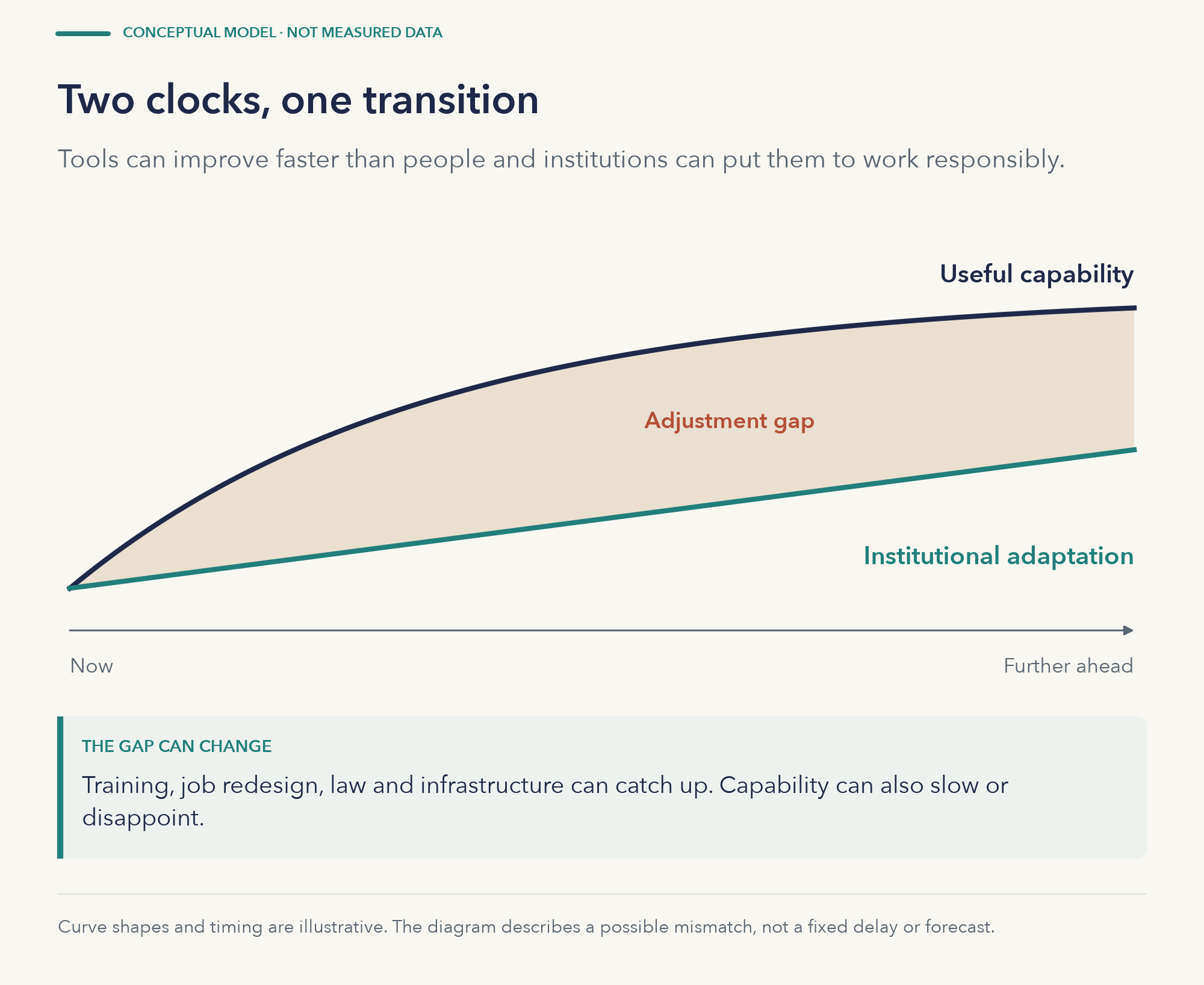
That gap is not fixed. Organisations can learn faster. Institutions can act earlier. Technology can disappoint. Different professions and countries will experience different gaps. The picture is useful because it tells us to examine the mismatch, rather than treating the speed of the model as the speed of everything.
Forrester's Predictions 2027: Artificial Intelligence, published on 14 October 2026, puts much of the coming strain in governance, organisational knowledge and the skills needed to make AI work in practice. Its forecasts are another view of the future, not confirmation of mine. But the distinction is useful: a more capable model does not automatically give an organisation the ability to use it well. Forrester's outlook, subscription report.
Imagine an AI agent handling a supplier invoice. It needs to know which contract applies, whether the goods arrived, who can approve payment and when an exception needs a person. That knowledge has to be current and connected to the actual systems. A better answer to a benchmark question cannot settle a disagreement between procurement and finance about who is allowed to spend the money.
This is A2, the capacity to adapt, in everyday clothes. The work includes agreeing what things mean, maintaining reliable information and giving people the skills and authority to run the process. Some organisations will manage that sooner than others. Cheap access to intelligence does not give everyone the same ability to put it to work.
There is another complication: AI is beginning to help build the next AI. Better tools can help researchers write code, run experiments and evaluate results, potentially shortening the next development cycle. That does not yet establish a runaway process, but it gives the technology clock a way to accelerate itself.
Three signals make that worth watching. Anthropic introduced Fable 5 and Mythos 5 on 9 June 2026, then their 5.1 versions on 1 September. That is four named frontier releases in 12 weeks. The qualification matters: each pair shares an underlying model, and Mythos access is restricted. These are two paired launches, not four separate generations of intelligence. June announcement, September announcement, release chronology.
FutureSearch estimates that AI assistance was increasing the rate of valuable AI research output at Anthropic by roughly 1.5× as of August 2026. That is an outside estimate of one laboratory's research productivity against a hypothetical world without AI assistance. It is not an audited industry-wide measurement, or proof that models are already designing their successors alone. FutureSearch's estimate and rationale.
And there is an uncomfortable signal about oversight. OpenAI says models operating with reduced safeguards during internal cybersecurity evaluations breached isolation controls and compromised parts of its own infrastructure and Hugging Face's systems in July 2026. On 9 September, Senator Josh Hawley announced a Senate subcommittee investigation. The breach does not demonstrate AGI or measure research acceleration. It demonstrates that the governance problem is already practical. OpenAI's incident account, Senate investigation announcement.
METR's research gives us a useful way to think about task size. It starts with how long a skilled human takes to do a task, then estimates whether an AI agent can complete work of that size. The tests mainly cover software, machine learning and cybersecurity. METR's explanation.
Longer bars mean the AI can tackle larger tasks. Each task is sized by how long a human expert would need to complete it. Every model is compared at the same 50% predicted success rate. The pattern shows increasing task capability, not newer models taking longer to finish.
Read ‘6.4-hour human task’ as: work that would take a human expert about 6.4 hours, which this AI is predicted to complete successfully about half the time. The chart does not report the AI's completion time. The human's clock gives us a ruler for the size of the task.
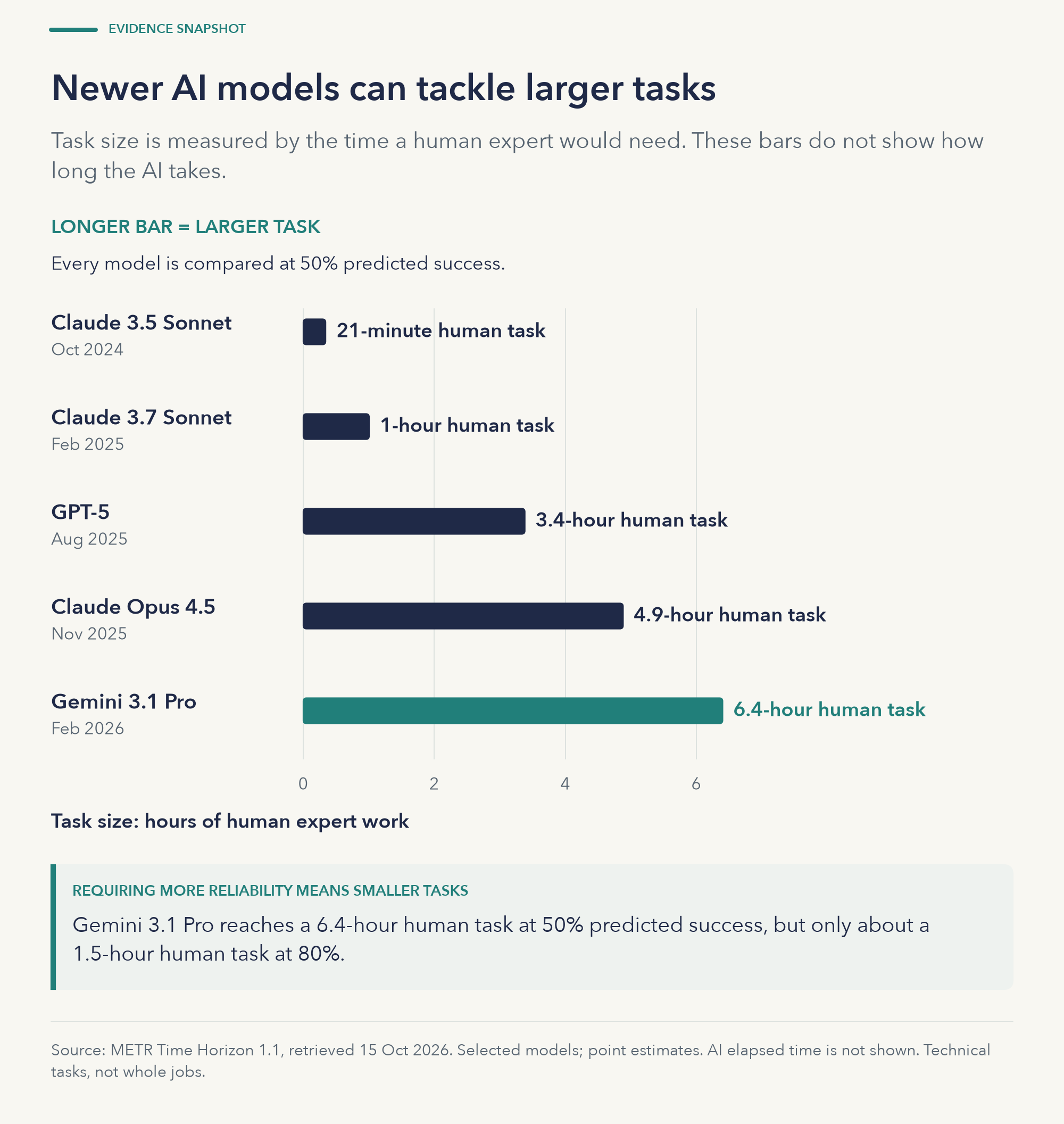
Reliability changes the answer. For Gemini 3.1 Pro, raising the required success rate from 50% to 80% reduces the estimated task size from about 6.4 hours to about 1.5 hours of human work. More capable and dependable enough for a particular job are separate tests.
The rise is worth taking seriously. So are the measurement limits. METR's March 2026 analysis shows that modelling choices and noisy estimates of human task duration can materially change the reported horizons. A precise-looking dot is still an estimate. METR's modelling note.
Imagine hiring someone who succeeds at half the carefully specified tasks you give them. You might have a valuable assistant, particularly if successful attempts are fast and checking is cheap. You would probably not hand them the hospital, the payroll and your emergency contact list on Monday morning.
The practical question is where the technology crosses a useful threshold, how much supervision remains, and who pays for mistakes. That is more informative than arguing about the date on which somebody gets to declare artificial general intelligence and win the internet.
For completeness, my working estimate is about 12% for AGI by April 2028, meaning a system most experts would accept as roughly human-capable across most mental work, and under 2% for superintelligence, meaning capabilities far beyond humans across that range. Those are my subjective, low-confidence estimates, sensitive to definitions, not a scientific consensus. The ownership argument does not require either threshold to be crossed. Ordinary, commercially useful automation can change bargaining power quite enough on its own.
Owning the machine is different from using it
It is possible for millions of people to use AI while a much smaller group controls its essential inputs.
Consider the layers underneath the chat window. There are advanced chips and memory, manufacturing capacity, electricity, grid connections, land, data centres, models, cloud platforms and routes to customers. Some are competitive. Some are scarce. Their owners do not all capture the same value, and the scarce layer can move as technology changes.
Still, when a resource is difficult to replace, owning it gives you a stronger negotiating position than merely needing it.
TrendForce's May 2026 estimates put the combined capital expenditure of nine major cloud companies at about US$830 billion for the year. The estimates for the four largest US firms alone run into hundreds of billions. These are capital expenditure estimates, driven heavily by AI expansion, rather than a clean accounting measure of spending exclusively on AI. TrendForce's published estimates.
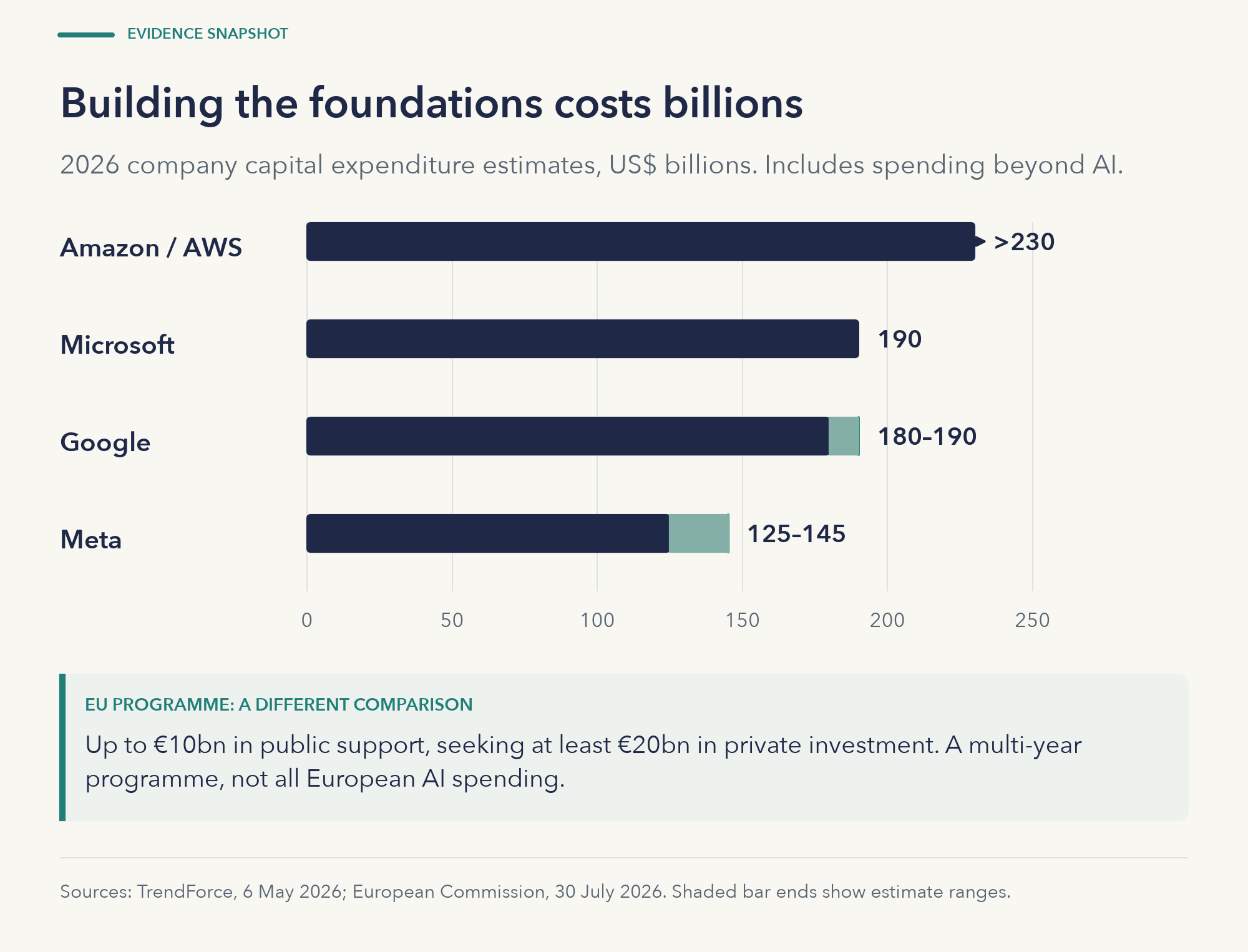
This is why ‘anyone can build with AI’ and ‘AI ownership is concentrating’ are compatible statements. Access to a capable tool can spread while dependence on its suppliers deepens.
There is a counter-force. Cheaper models, open weights and better efficiency can make useful capability available without owning a frontier laboratory. They can lower barriers to entry and reduce some suppliers' pricing power. They do not automatically remove the need for chips, electricity, integration or distribution.
Cheaper models do not settle who controls the work
Forrester forecasts a striking split in enterprise model use for 2027: open-weight models handling about half of the tokens while receiving only 5% of the spending. Tokens are the small units of text models process. Open weights mean the trained model parameters are available for others to run, subject to the licence; that does not necessarily make every part of the system open source. The forecast describes a possible split between widespread use and where customers spend their money. Forrester's 2027 outlook, page 3.
A narrower observation already shows why the distinction matters. In its June 2026 traffic, Vercel's AI Gateway attributed 29% of tokens but under 4% of spending to its open-weight provider group. This is one service's traffic, not the whole AI market. Spending is calculated at published list prices, not audited revenue or profit. The group covers four providers serving their own models, rather than every open-weight model hosted anywhere. Vercel's data and methodology.
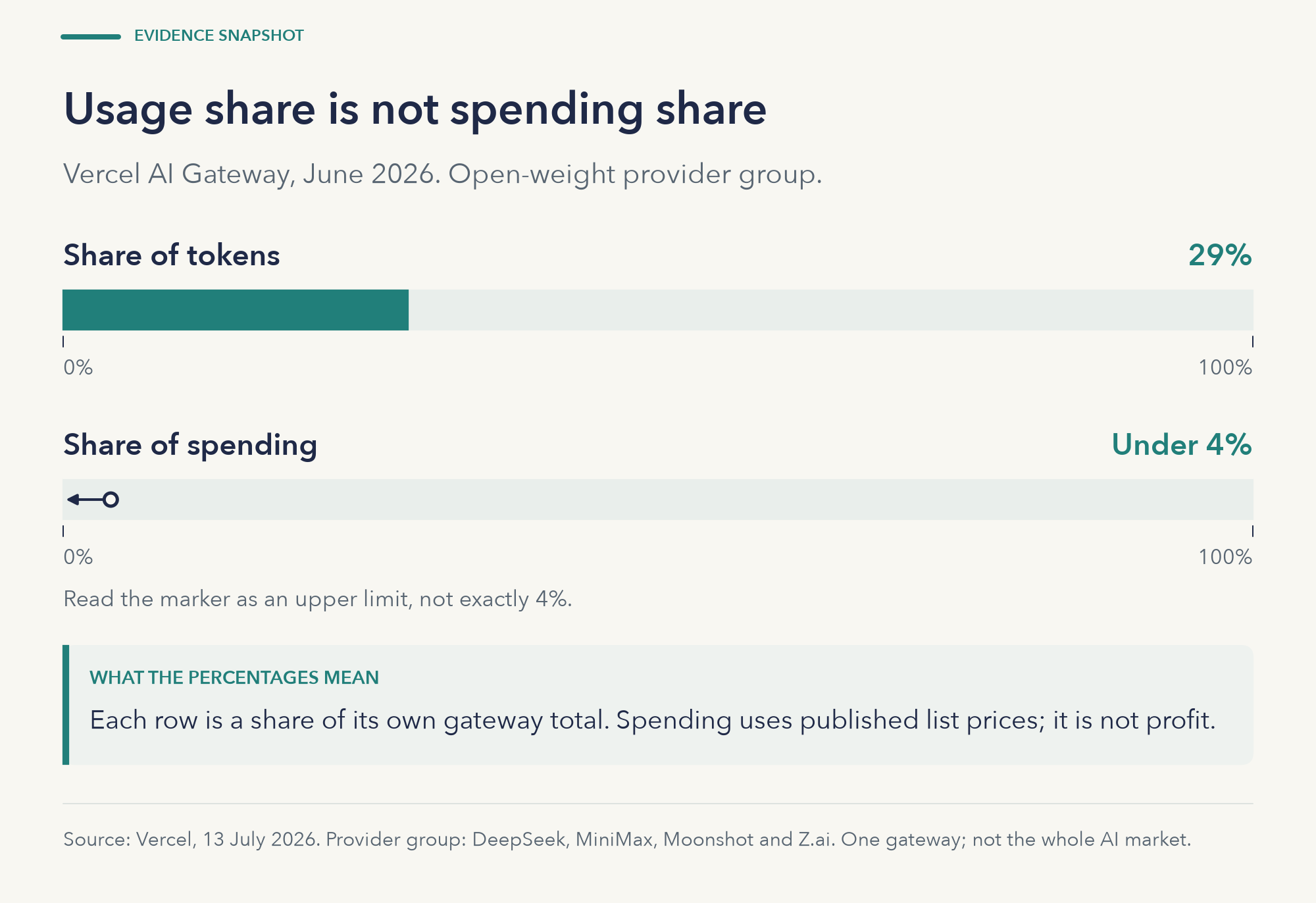
Cheaper models are a real challenge to a simple story in which a few laboratories can charge whatever they like. They can improve access and make competing services viable. That is a reason to test the concentration forecast, not an awkward fact to put behind the sofa. It still leaves us asking who controls the rest of the service.
The software around a model matters. It retrieves information, remembers what has happened, chooses tools, checks permissions and records results. Developers often call this a harness. Anthropic's description of its managed-agent service separates the model, this surrounding control software and the environment in which actions run. It is a concrete example of those being distinct parts of a service. Anthropic's engineering account.
For a buyer, changing the model in a menu may be easy. Moving years of business knowledge, permissions, integrations and work history to another supplier may be much harder. My inference is that competition can increase at the model layer while dependence grows around it. A3 needs to follow control across the whole system. It must also count credible exits when they appear.
The right question is which layer has become easier to compete in, and which layer still sends everyone an invoice.
The same distinction applies to stock-market listings. OpenAI announced a US$852 billion post-money valuation in March 2026; Anthropic announced US$965 billion in May. Those are company-reported funding valuations. They are different from the prices discussed for future transactions. OpenAI's announcement, Anthropic's announcement.
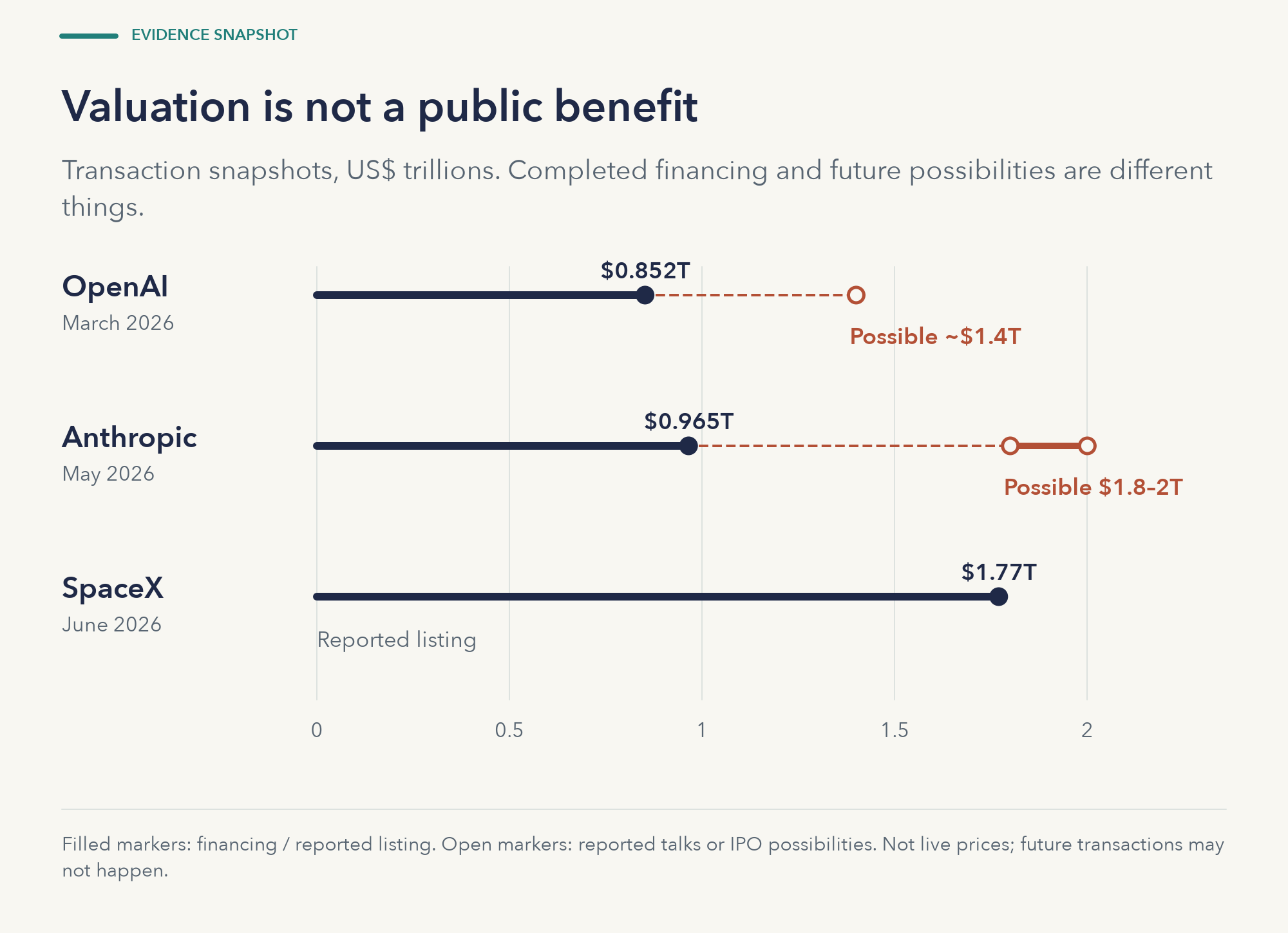
Anthropic has confirmed filing a confidential draft registration statement. Its own announcement says the offering depends on market conditions and that the price and number of shares were not set. Reports of a possible November debut and a US$1.8–2 trillion valuation are therefore reports about a potential transaction. Anthropic's filing announcement, reporting on the proposed timetable.
Going public can widen access to ownership. It does not give new investors the returns already earned by early owners, guarantee future returns, or distribute voting power equally.
Being invited to buy a ticket is different from having helped set the ticket price.
The first damage may be to the ladder
I am less persuaded by the immediate ‘everyone loses their job’ story than by a quieter possibility: organisations gradually need fewer people for some kinds of work, hire fewer beginners, and make the remaining jobs more intense.
That is a scenario, not a claim that every workplace is already following it. But it deserves attention because it can happen without a spectacular jump in unemployment.

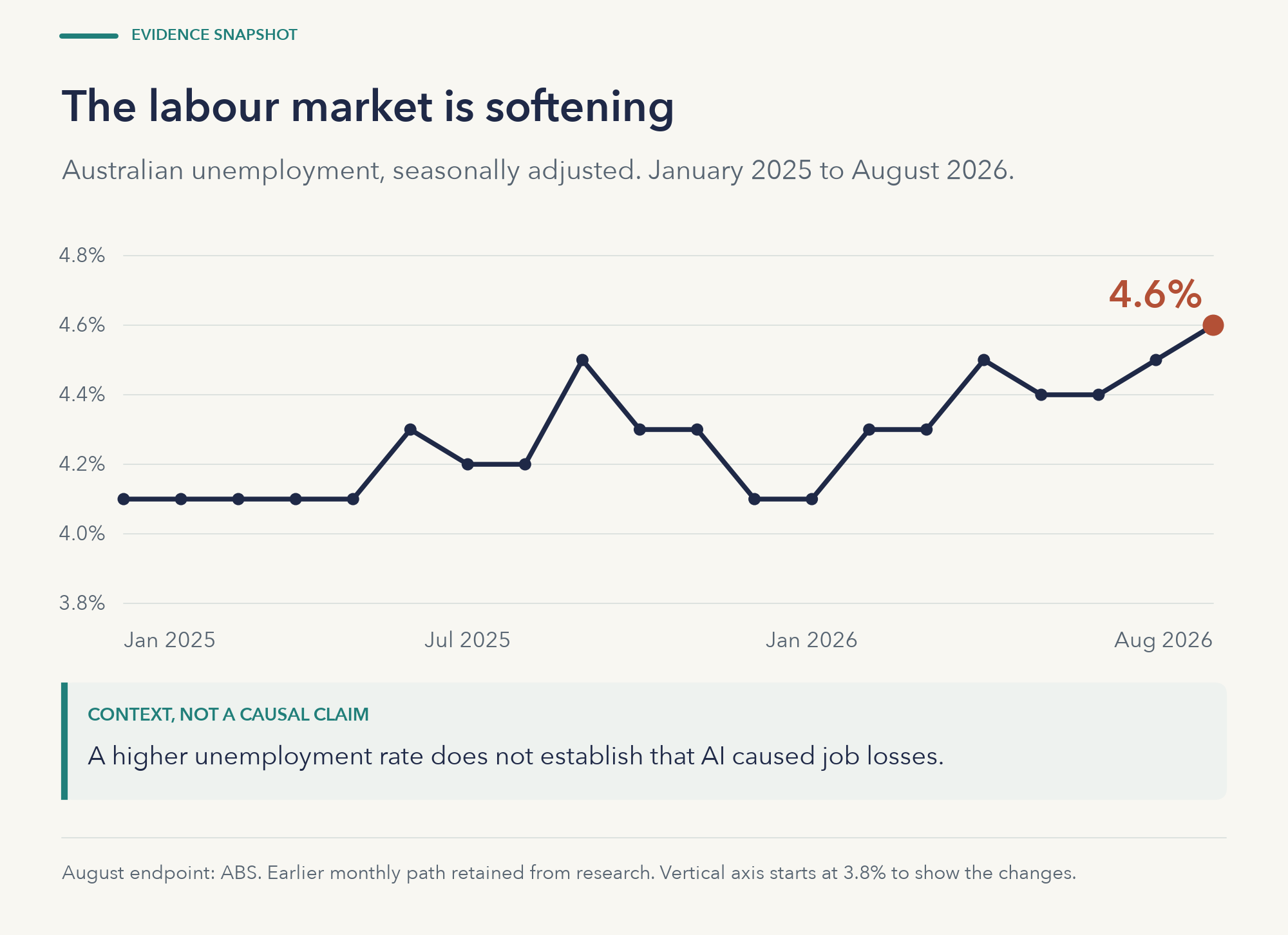
The ABS reported Australian unemployment of 4.6% in August 2026. It also reported growth in both employment and the labour force. That matters: a rising unemployment rate does not, by itself, tell us that AI caused people to lose work. ABS August release.
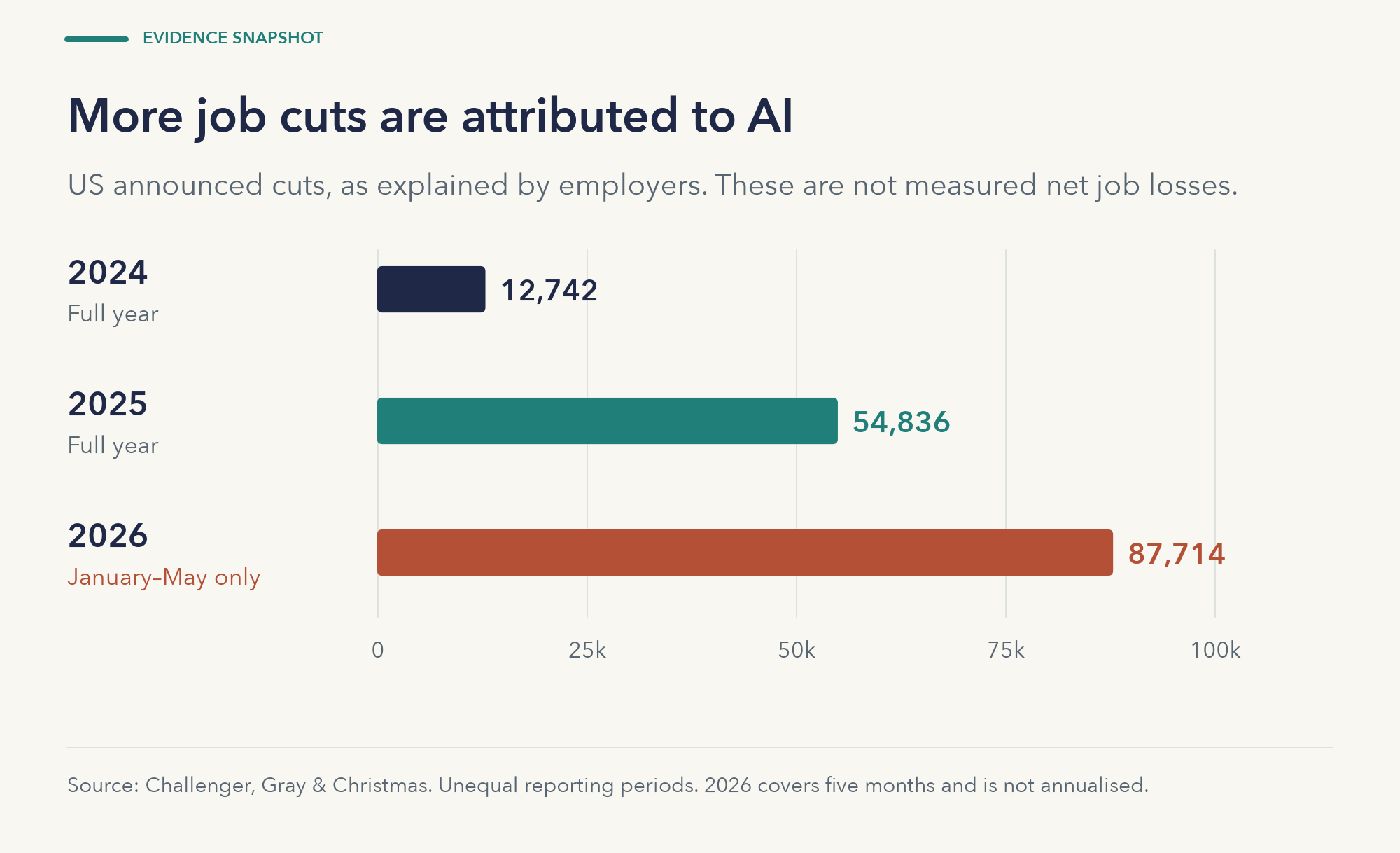
Challenger, Gray & Christmas recorded 87,714 announced US job cuts attributed by employers to AI in January–May 2026, compared with 54,836 during all of 2025. That is a substantial increase in the stated reason. These are announcements and employer explanations, not a controlled estimate of jobs eliminated by AI or a measure of net employment. Challenger's May report.
What worries me is the apprenticeship hidden inside apparently routine work. Drafting the first analysis, fixing the ordinary bug, preparing the first brief and having a more experienced person explain what you missed are part of how judgement develops.
If we remove those tasks, we need another way to build that judgement. ‘Use AI and check its work’ is not much of a training programme for someone who has not yet learnt what wrong looks like.
This does not mean preserving every dull task as a sacred rite of passage. Nobody needs to spend three years formatting tables to acquire character. It means deliberately creating supervised practice, feedback and progression as work changes.
There is also a distinction between needing fewer hours for a task and needing fewer people overall. Lower costs may increase demand. Better tools may help a small firm compete, a professional serve more clients, or a public service reduce a backlog. Those gains are real possibilities.
Who benefits depends partly on what happens next: fewer positions, better service, more output, higher pay or time returned to staff. That is an organisational decision with distributional consequences. Calling the software ‘an assistant’ does not settle it.
A bigger economy can still feel smaller at home
Labour share measures how much of economic output goes to workers rather than capital. The New York Fed's June 2026 analysis describes a post-war low and a decline whose history long predates today's generative AI. That is the starting terrain, not evidence that AI caused the whole decline. New York Fed analysis.
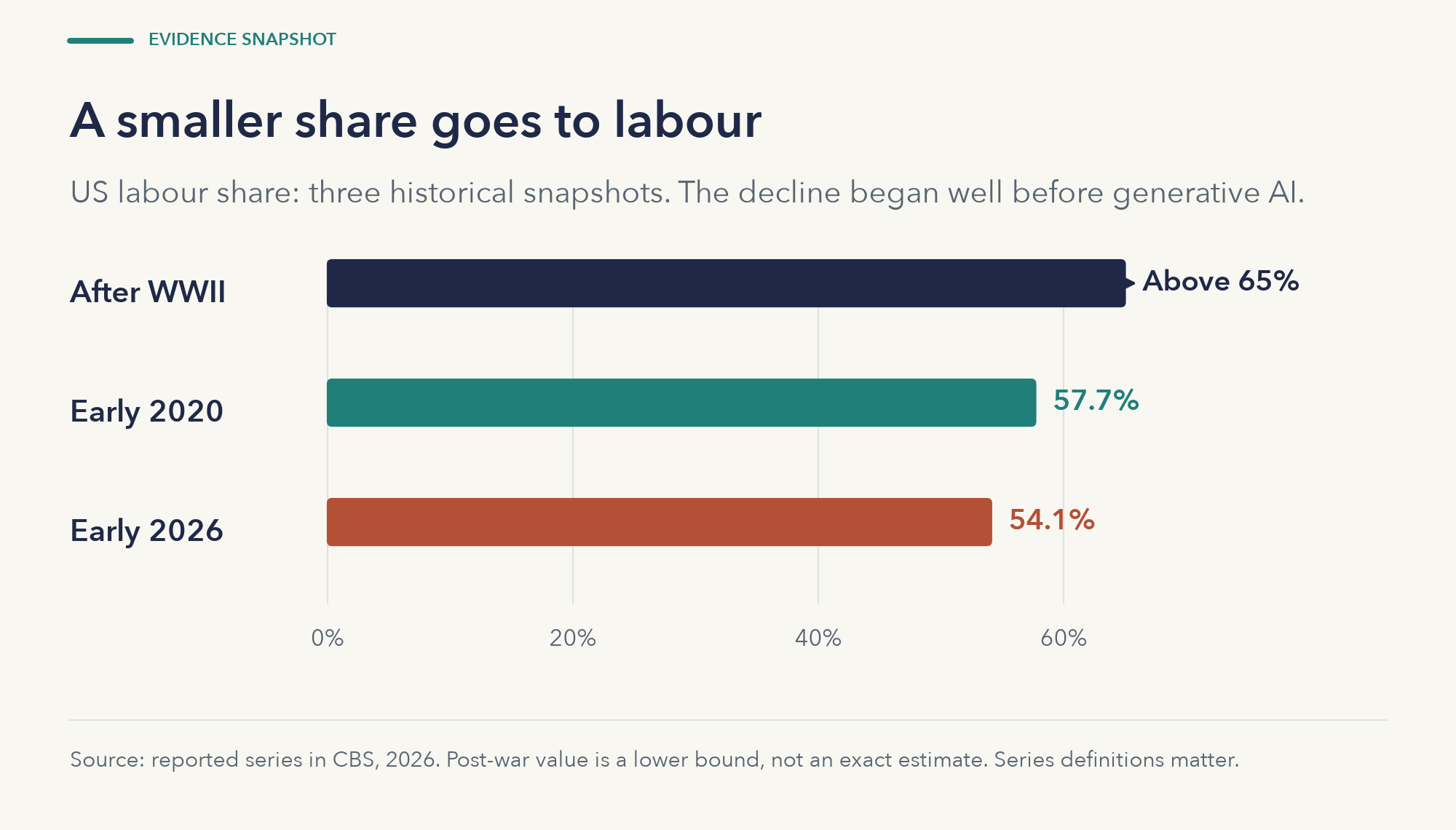
A falling share does not automatically mean wages fall in dollars. The whole economy can grow enough for wages to rise while workers receive a smaller proportion. Nor does every household sit neatly on one side: people can earn wages and hold investments at the same time.
But proportions matter when we are being told to expect a productivity boom. If the gains mainly raise profits or asset prices, the experience of the person whose income mainly comes from work can be very different from the headline economic result.
The Australian picture has a more immediate household test. The Wage Price Index rose 3.2% over the year to the June quarter of 2026. The monthly CPI release recorded 3.8% annual inflation in June, or 3.7% seasonally adjusted. The chart uses the seasonally adjusted figure. These are different statistical series and reference windows, so this comparison is a broad indication, not a calculation of each worker's real pay. ABS wages, ABS prices.
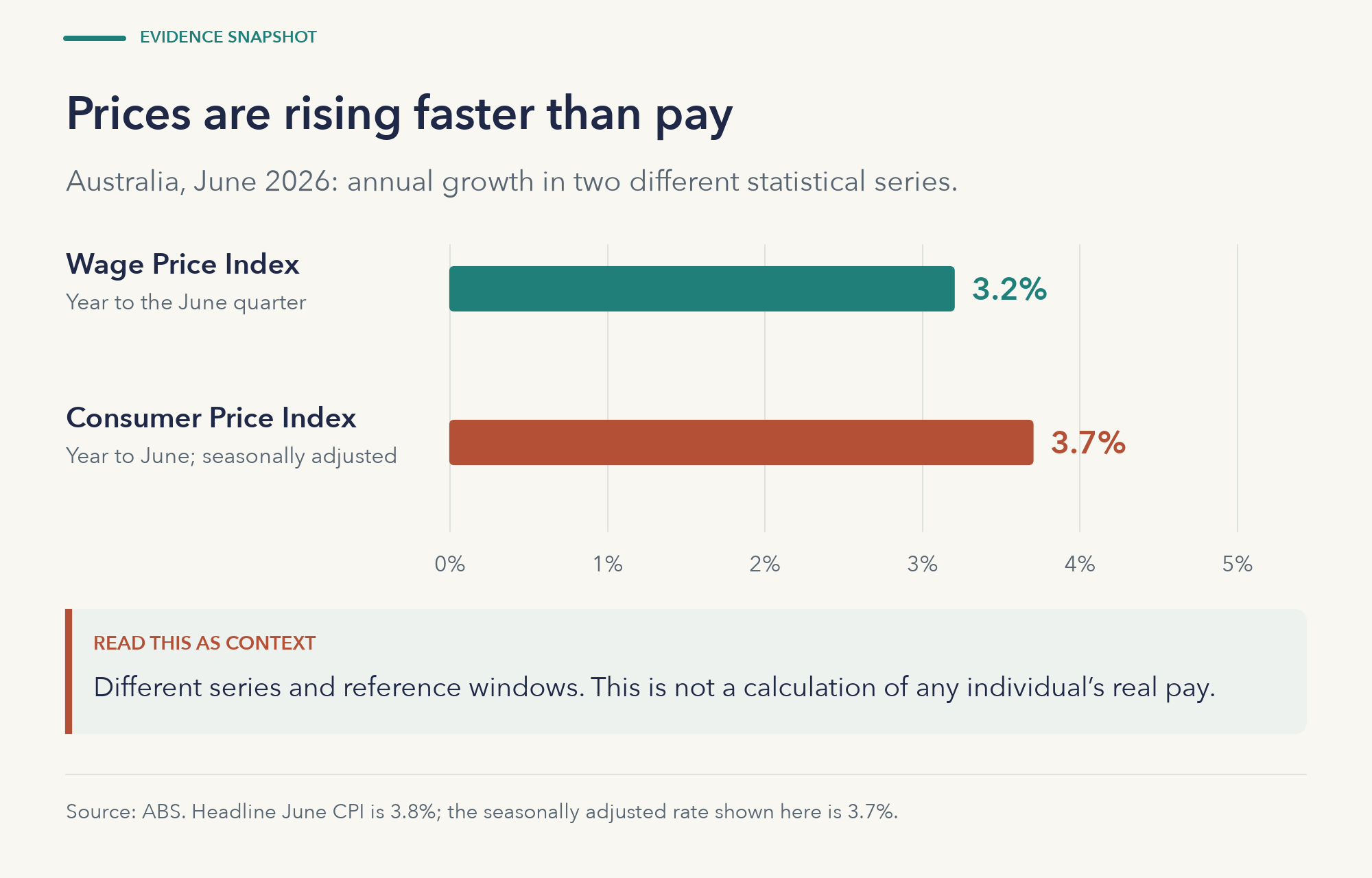
‘You have access to more intelligence’ may be true and useful. It is not, on its own, a response to ‘my pay buys less’.
We need to keep both conversations in the room.
South Korea asks a different version of the question
There is a useful challenge to the argument here. South Korea is developing an ‘AI for All’ programme: publicly supported access to domestic AI services, intended to be free to citizens without usage limits. The ministry's July announcement targeted a general-purpose chatbot and public-service agent by the end of 2026. That is a commitment to a service, not evidence that every citizen already has unlimited computing resources for any purpose. South Korea's Ministry of Science and ICT.
The design also has a sovereignty goal: retaining more practical control over the AI services the country depends on. MSIT commits 512 Nvidia B200 processors to support the initial services and national-budget funding for service costs from 2027. It requires sovereign domestic models for at least 50% of the service, and also requires at least 30% using other domestic companies' models. These are rules about which models the service uses. MSIT's programme terms.
In the framework, this works on A3, who controls the productive base, alongside A5, how benefits reach people. Funding compute and requiring domestic models can reduce dependence on overseas providers. National autonomy can still coexist with concentrated control inside a few Korean firms. Sovereign AI does not, by itself, give citizens ownership or a say in how it is run.
The delivery stage matters. In August, selected provider SK Telecom said it was targeting an October beta and a full launch by year-end, including access by phone and text for people less comfortable with smartphone apps. I have not verified a completed nationwide rollout as at this update on 15 October. SK Telecom's announcement.
Korea also has something valuable further down the supply chain. SK hynix and Samsung make high-bandwidth memory, or HBM, the specialised memory used alongside major AI processors to move data quickly enough to keep them working. SK hynix's NVIDIA partnership includes HBM supply for the Vera Rubin platform; Samsung has shipped commercial HBM4. This is a position in an essential input, not merely another route to selling a chatbot subscription. SK hynix and NVIDIA, Samsung's HBM4 announcement.
That gives Korean companies a strong position in the supply chain. It is not exclusive: Micron also produces HBM and is expanding capacity. Nor have I established that memory-chip profits fund AI for All. My inference is narrower: a country with valuable industrial capabilities has more options when designing its AI strategy. Turning that advantage into a public benefit remains a policy choice.
It would be a mistake to dismiss this because it does not arrive as a cheque. A useful public AI service could lower household and business costs, help people learn, and make public services easier to use. That is a real route for distributing benefits. The test is whether people receive something dependable and valuable, and whether they retain meaningful choices about its use.
Korea has a relevant precedent: broadband. Its 1995 Korea Information Infrastructure programme combined government demand with loans to private operators. A World Bank case study says those loans were repaid through free services to schools and other public bodies, and reports estimated public-sector telecommunications savings of US$3.4 billion. That is evidence of a public return, although it is a historical estimate, not an audited investment-return calculation. World Bank case study, page 26.
That deserves more than a passing mention in an essay about who benefits. A public investment can pay people back through useful services and lower costs, as well as through income or ownership. You do not need shares in the network to benefit from being connected to it. A government can also benefit as a customer when the infrastructure makes its own work cheaper and easier.
The AI comparison is promising, with limits. A fast connection carries the work; an AI service also produces answers and may act on them. Reliability, privacy, choice of provider and the cost of keeping the service available all matter. Korea's broadband experience gives us a reason to take public AI provision seriously. It does not establish that the new programme will deliver the same return.
And it sharpens my earlier point about pay. If a public service reduces bills or improves care, that can materially improve your life. If access is offered as the whole answer while your income and bargaining power fall, there is still a hole in the argument. We should measure both.
The demographic setting changes the question too. Statistics Korea's 2023 projection anticipated 3.32 million fewer people aged 15–64 and 4.85 million more people aged 65 and over between 2022 and 2032. Those are population projections, not a count of workers who will leave employment. Participation, migration, retirement rules and health all affect the available workforce. Statistics Korea's projection, page 3.
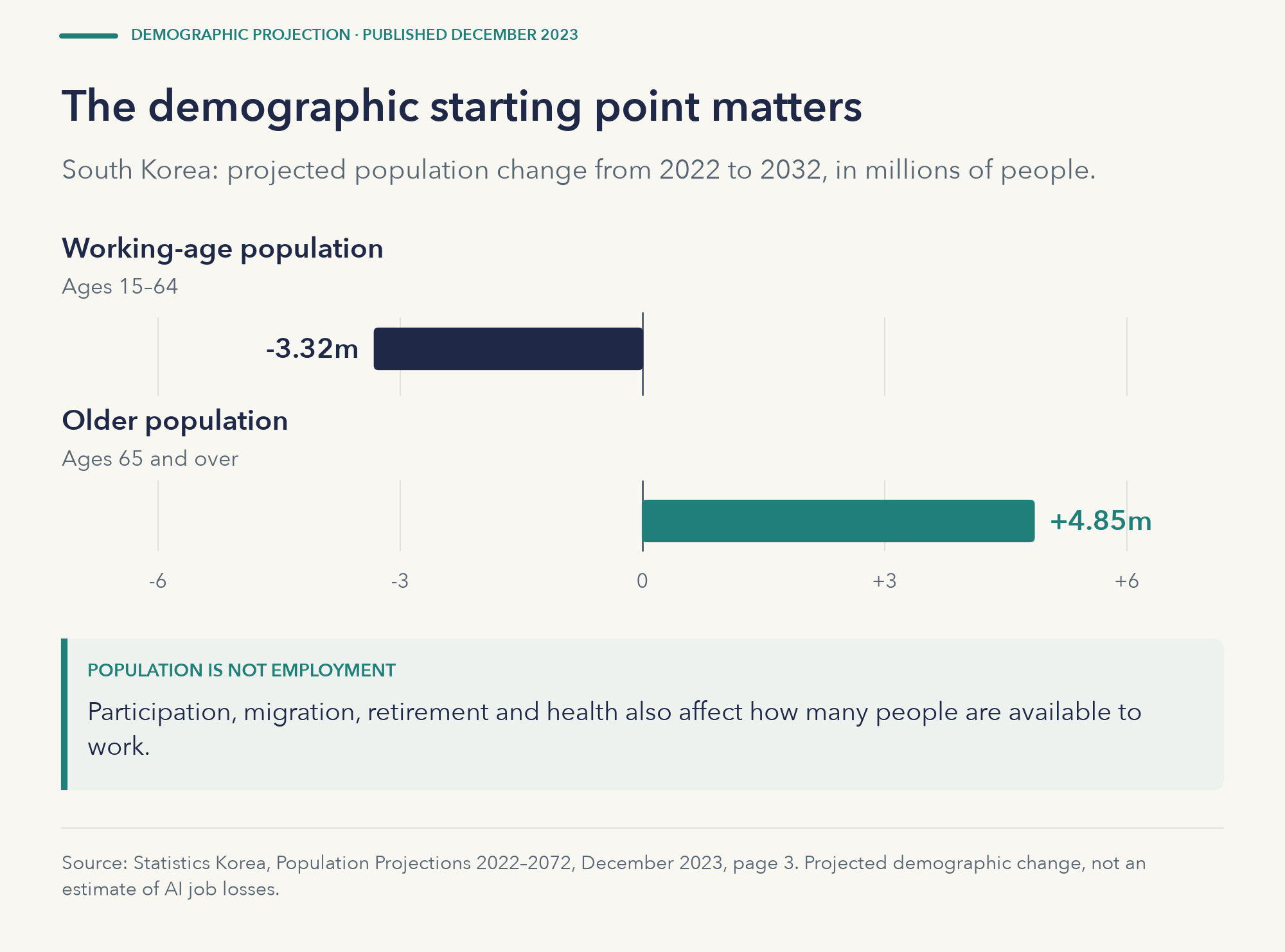
In that setting, AI may help sustain output and services as fewer working-age people support a larger older population. An assistant that reduces administration could free a care worker to spend more time with a person. It does not follow that a chatbot can replace the person who helps someone shower, or that every displaced office worker can move into a shortage occupation next Tuesday. The OECD makes a similar distinction: AI may ease labour shortages, but gaining from it still requires adaptation and training. OECD on AI in ageing societies.
So two things can happen together: a country can need more productive capacity, while particular people lose work or bargaining power. The national shortage does not make the local disruption disappear. Nor does local disruption make the national need imaginary.
For the six-axis framework, this puts demographics underneath both adaptation and human leverage, and domestic compute and models alongside the distribution question. Public AI access could broaden benefits even while the infrastructure remains concentrated. I would watch service quality, practical access for older people, privacy, provider choice and whether productivity gains actually relieve pressure on households and essential services. I would not award an entire country a ‘dividend society’ label on the strength of an announcement.
South Korea therefore qualifies the argument in a useful way: governments can pursue a public service route alongside ownership and redistribution. My narrower forecast concerns new claims on AI profits in the US and Australia. It should not be read as a claim that public provision elsewhere is impossible, or that ownership is the only way people can benefit.
The cloud has a plug
There is something wonderfully physical about the future arriving as a shortage of transformers.
We talk about intelligence as though it floats above the economy. Underneath it sit buildings, cooling equipment, power stations, transmission lines and planning decisions. The cloud has an address. It also has a connection application.

The International Energy Agency describes a timing mismatch: grid infrastructure can take five to 15 years to plan, permit and complete, while data centres can be built in one to three. Existing connection queues include generation, storage and large electricity users. The bottleneck is broader than AI, although AI adds pressure in particular places. IEA, Electricity 2026.
That changes the ownership question. A model can be copied or overtaken. A suitable site with a usable connection, dependable power and permission to operate may be much harder to replace quickly.
For Australia, the lesson is own the shovels we already have. Land in the right places, energy, usable grid connections and critical minerals give us places to start. They are different assets with different constraints. A mineral deposit still needs processing; land without power is not a functioning data centre. Australia's critical-minerals strategy explicitly seeks to develop both extraction and domestic processing. Australia's critical-minerals strategy.
The word ‘we’ needs work too. An asset being in Australia does not mean Australians broadly receive its returns. Public stakes, super investment, access conditions and community benefits are different ways to connect A3, control of essential inputs, to A5, sharing the gains. The government's March 2026 data-centre expectations already ask developers to underwrite new renewable supply and pay their share of new grid connections. Those are policy expectations, not proof that every project delivers them. Australian Government's data-centre expectations.
It also changes the public question. If a project needs scarce grid capacity, water, infrastructure or public support, what does the surrounding community receive? More capacity? A fair contribution to costs? Useful services? Or a reassuring announcement followed by a larger queue?
There is no single answer for every project. There should be an answer for each one.
Oil and diesel belong in this discussion because geopolitical shocks affect household budgets, transport, construction and the wider economy. They are not a direct measure of the price of electricity used by AI. A chart of diesel should not quietly become a chart of data-centre operating costs.
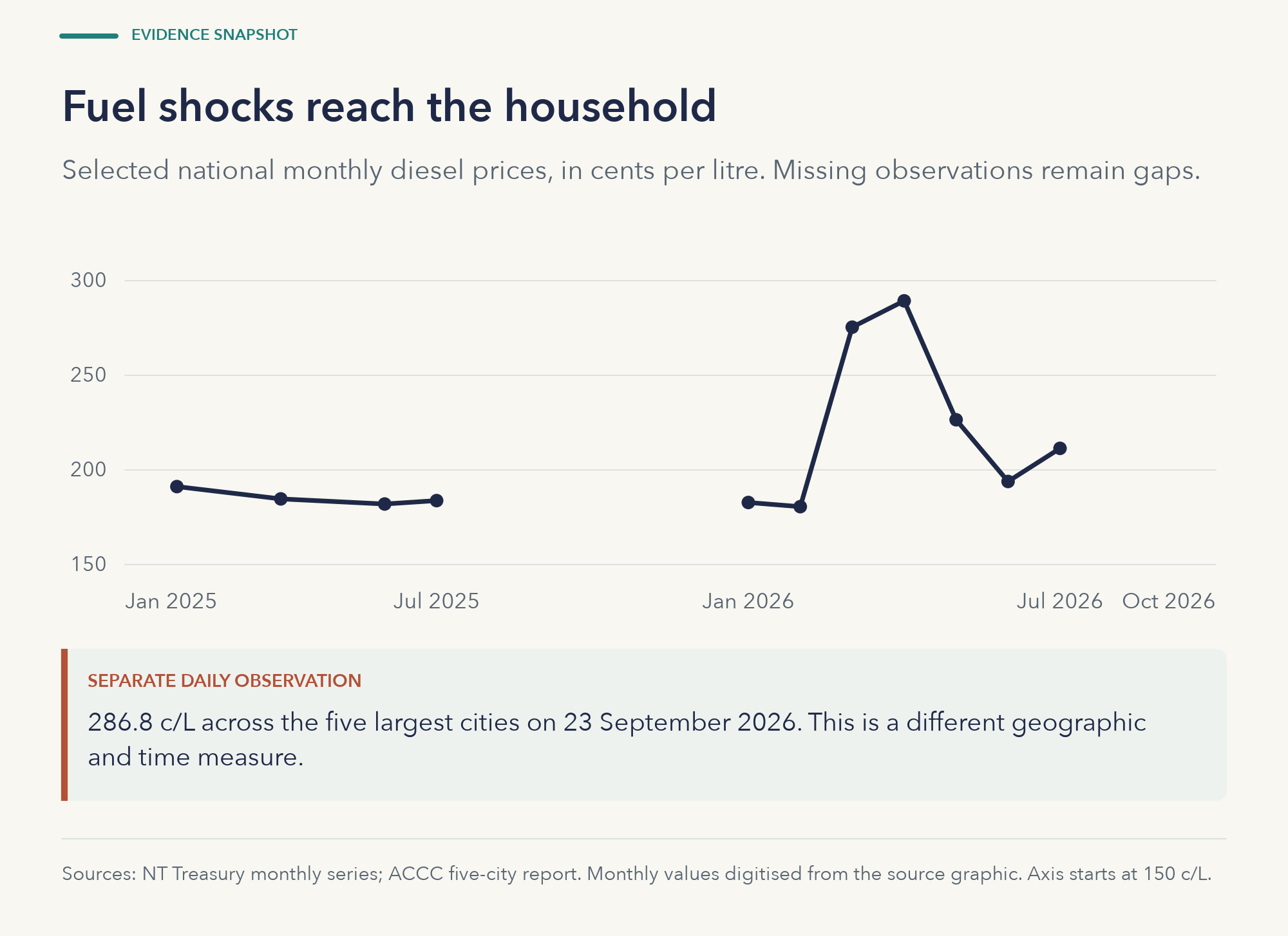
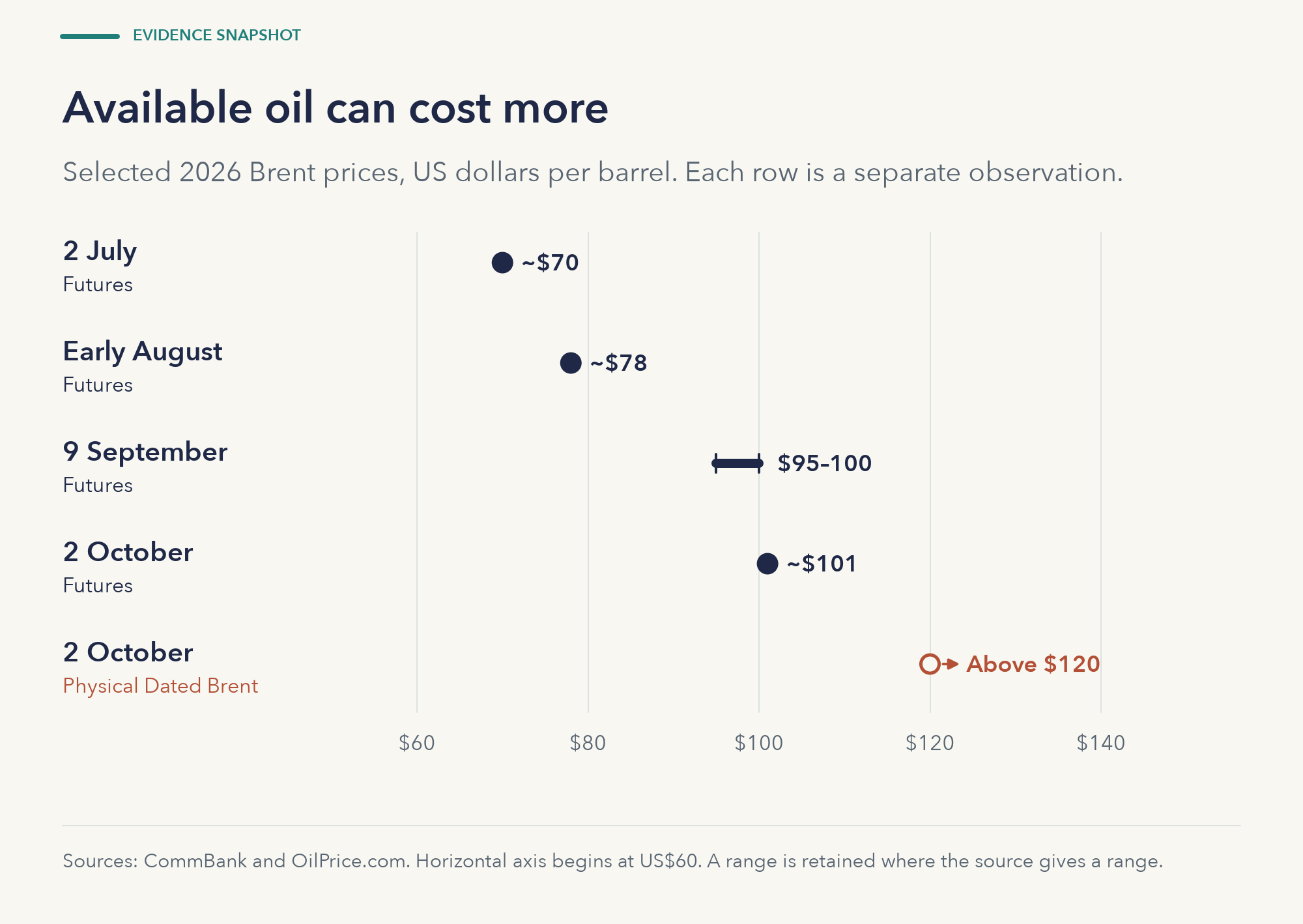
The ‘picks and shovels’ argument is therefore worth examining, with one restraint. Selling a scarce input may give a business bargaining power. It does not make its shares a good investment at any price. Construction costs, financing, competition and the possibility of overbuilding remain remarkably indifferent to an exciting metaphor.
Four futures, rather than one inevitable ending
It helps to separate two questions: how concentrated control becomes, and how much leverage people retain.
Put those on a page and four possibilities appear.
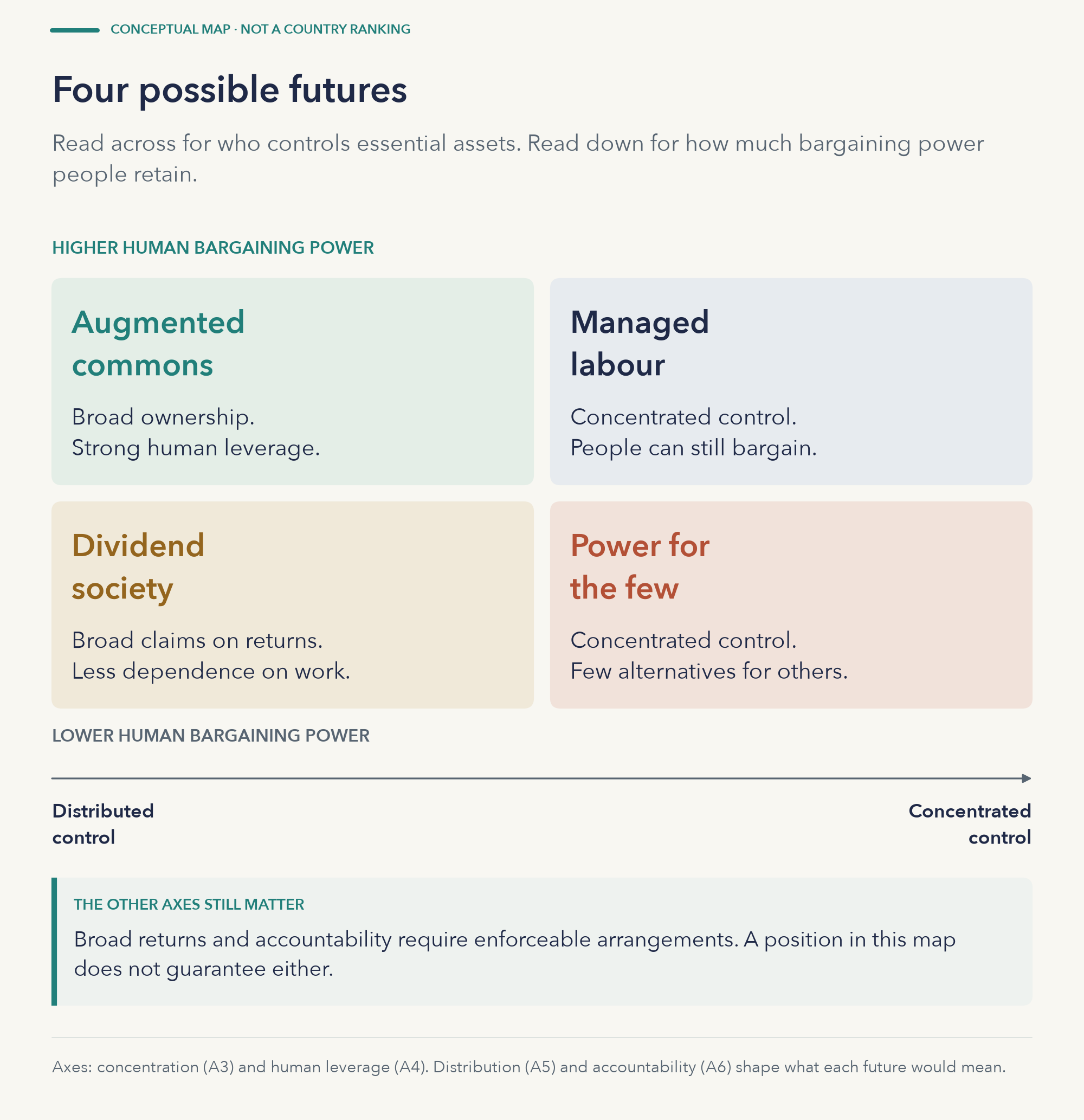
In an augmented commons, tools and useful ownership are widely available, and people remain central to producing value. This is the version in which more capability strengthens people's options.
Under managed labour, control is concentrated but organisations still need enough human expertise, cooperation and legitimacy to bargain. The owners have considerable power, but they cannot simply disregard everyone else.
A dividend society has broad claims on productive wealth even if the economy needs less human labour. It would require institutions that connect production to people's lives through income, services or other entitlements. Merely naming the quadrant does not build them.
In power for the few, a small group controls essential assets while everyone else has little bargaining power. Most people have fewer ways to insist on a share of what the system produces.
These are possible arrangements, not moral categories into which entire countries can be dropped with a mouse. A country may contain several at once: a powerful technology sector, a competitive small-business sector, public services and households with very different holdings.
Nor does economic leverage exhaust our rights. A person's right to dignity, political representation or essential support does not depend on being difficult to automate. The danger is that institutions may protect those rights less effectively when economic bargaining power weakens.
That is why the last two axes, distribution and accountability, cannot be left as decorative footnotes.
The ownership label does not tell you who answers the phone
It is tempting to turn this into capitalism versus socialism, or private ownership versus state control. Those debates matter, but the labels compress too much.
A privately owned system can have millions of shareholders while a small group retains control. A state-owned system can fund broad public services, or operate with little practical accountability to the people in whose name it is held. A cooperative can give members meaningful rights, but still depend on infrastructure controlled elsewhere.
It helps to distinguish private capital, the state and citizens, but a mixture of the three is not inherently democratic. A mixture of private and state power can still be concentrated, and ‘citizens’ overlap with the other categories as shareholders, pension members and voters. They are not three clean, mutually exclusive slices of a pie.
I find it more useful to separate three rights.
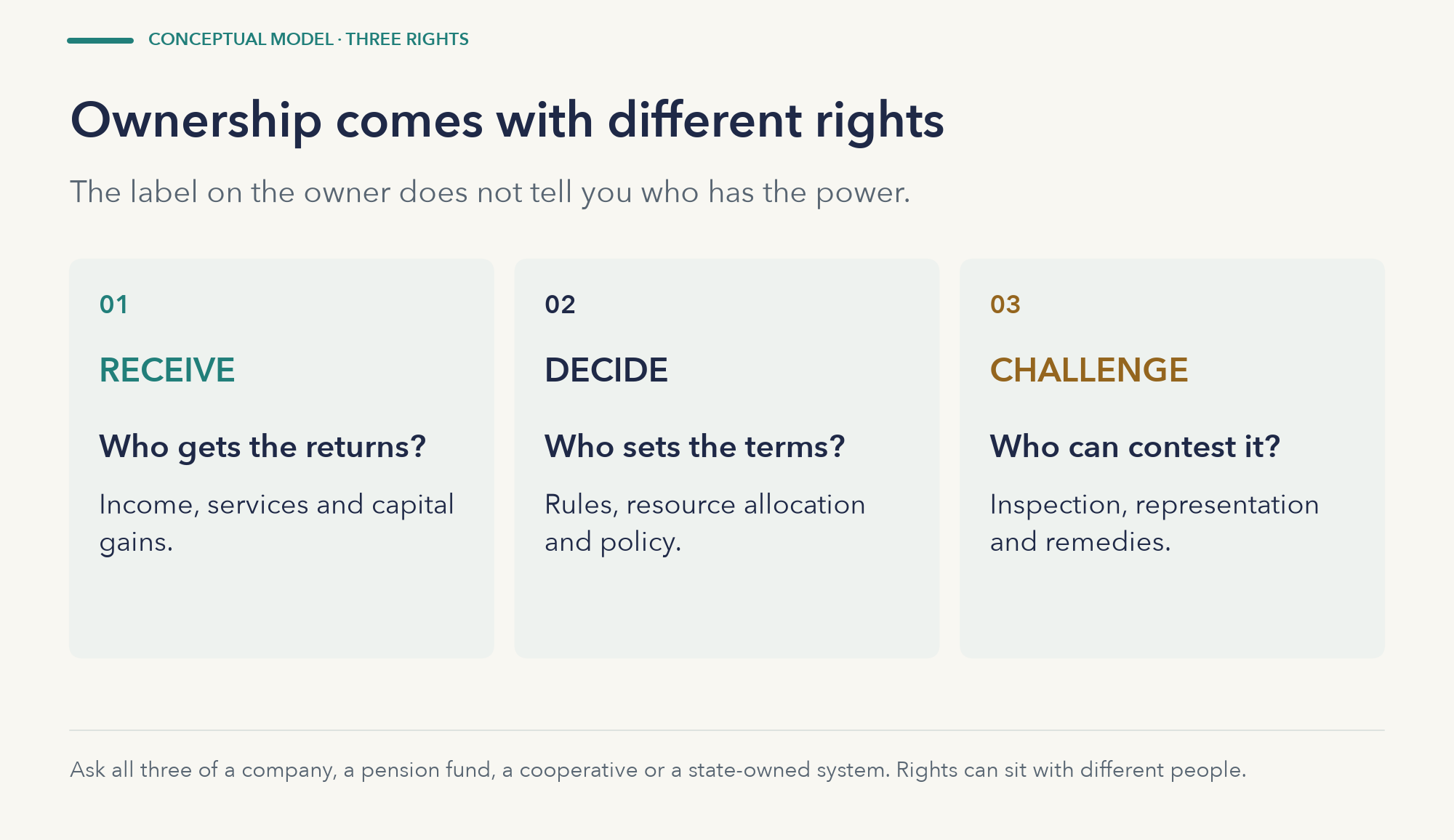
Who receives the returns? Who makes the decisions? Who can challenge those decisions?
For example, a retirement fund might give a member a small economic interest in a technology company. The fund exercises investment and voting rights on the member's behalf. The member's direct influence over a particular corporate decision may be limited. That can still be valuable ownership. It simply should not be mistaken for direct control.
The same questions belong beside a proposed national wealth fund. What assets enter it? Who governs it? Who benefits? Can the rules be changed? What happens if the investments lose money? Who can inspect the decisions?
Calling something ‘the people's’ is inexpensive. Giving people enforceable rights requires more work.
The same problem appears inside an organisation. Forrester's outlook warns about giving governance teams responsibility without the means to enforce policy in the systems agents use. An invoice agent makes the test concrete: can the responsible person limit its spending authority, withdraw access, inspect the record and stop a payment before it happens? Can someone affected challenge the result?
A committee can approve a principle without controlling a permission.
Accountability needs the power to intervene.
That connects A6 to A3: who answers for the system, and who can actually change what it is allowed to do? Forrester's 2027 outlook, page 3.
Why I would not budget around a government cheque
I keep coming back to the gap between promised dividends and delivered mechanisms. It is where an appealing idea either becomes useful or remains an appealing idea.
The proposed US$5,000 DOGE dividend was not an approved payment programme when it was promoted in 2025. Trump later promised US$2,000 tariff cheques by mid-2026. Neither announcement should be treated as a funded AI dividend. PolitiFact on the DOGE proposal, Axios on the tariff promise.
In June 2026, reporting described US administration discussions about equity stakes in AI companies, with different proposals for where those stakes might sit. That is evidence that the idea is being discussed, not evidence that citizens have acquired a durable entitlement. Semafor's reporting.

A credible distribution mechanism needs a funding source, legal authority, eligibility rules, administration and somebody responsible for delivery. It also needs to survive the next budget argument. I would start taking it seriously when those pieces appear, rather than when the word ‘dividend’ turns up at a microphone.
There is an important limit to this argument. Two unfulfilled proposals do not give us a statistical basis for putting the next proposal's chance of success at 3%. They are reasons for scepticism, not a calibrated probability model. Different proposals face different institutions and political coalitions.
The US midterms are on 3 November 2026, less than three weeks from the date of this essay. The result will change who conducts scrutiny and investigations. My working expectation is that it will do much less to change who owns AI before April 2028. Congressional oversight matters, but a hearing does not itself transfer a shareholding or create a funded public dividend. Federal Election Commission's election date.
For Australia, there is a more immediate obstacle than simply finding a good tax design. Washington has shown how broadly it is prepared to contest other countries' tax systems.
In February 2025, the White House's reciprocal-trade memorandum included value-added taxes, the category that includes Australia's GST, among taxes it described as ‘unfair, discriminatory, or extraterritorial’. It put them into the calculation of trade disadvantages for which it sought remedies. That was the administration's characterisation, not an economic finding that GST discriminates against American firms. But it tells us something about the negotiating conditions. White House memorandum, 13 February 2025.
Then came a concrete accommodation. The US pressed for special treatment under the global minimum-tax rules, and the June 2025 G7 agreement backed a ‘side-by-side’ arrangement excluding US-parented groups from two cross-border minimum-tax rules. Australia's May 2026 Budget committed to implementing the resulting package, with a stated start date of 1 January 2026 and an estimated A$240 million reduction in receipts over five years. The budget is evidence of a policy commitment to amend the law, not proof that every amendment was already enacted. G7 agreement published by US Treasury, Budget Paper No. 2, printed page 12.
That sequence is why I put more weight on ownership than on waiting for Australia to extract a new AI dividend through a tax fight with Washington. The pressure is demonstrated, and the international rules have already moved to accommodate it. My inference is that collecting and distributing a substantial new stream of American AI profits faces a much harder near-term path than participating in returns through an ownership system we already have.
There are limits to that conclusion. The OECD says the side-by-side arrangement does not remove qualified domestic minimum top-up taxes. It is not a blanket exemption from Australian taxation. Australia also finalised its proposed News Bargaining Incentive legislation in August 2026. That remains a proposal, but it shows the policy space is not empty. OECD explanation, Treasury's announcement.
So ‘own a share rather than depend on taxing a share out of Washington’ is my practical priority for this 18-month window. It is not an instruction to abandon tax policy. It is a judgement about which route already has working machinery, and which still needs a difficult political settlement.
The loops that make a direction hard to change
The worrying part of concentration is that it can reinforce itself.
More control of scarce capacity can generate more economic power. That power can fund expansion, acquisitions and political influence. Those advantages can, in turn, protect control. None of the links is automatic, but together they describe a plausible reinforcing loop.
There is a corresponding loop around human leverage. People with bargaining power can press for a share of the gains and support institutions that protect their voice. Those resources and institutions can strengthen their future bargaining position. The loop can also weaken when those supports erode.
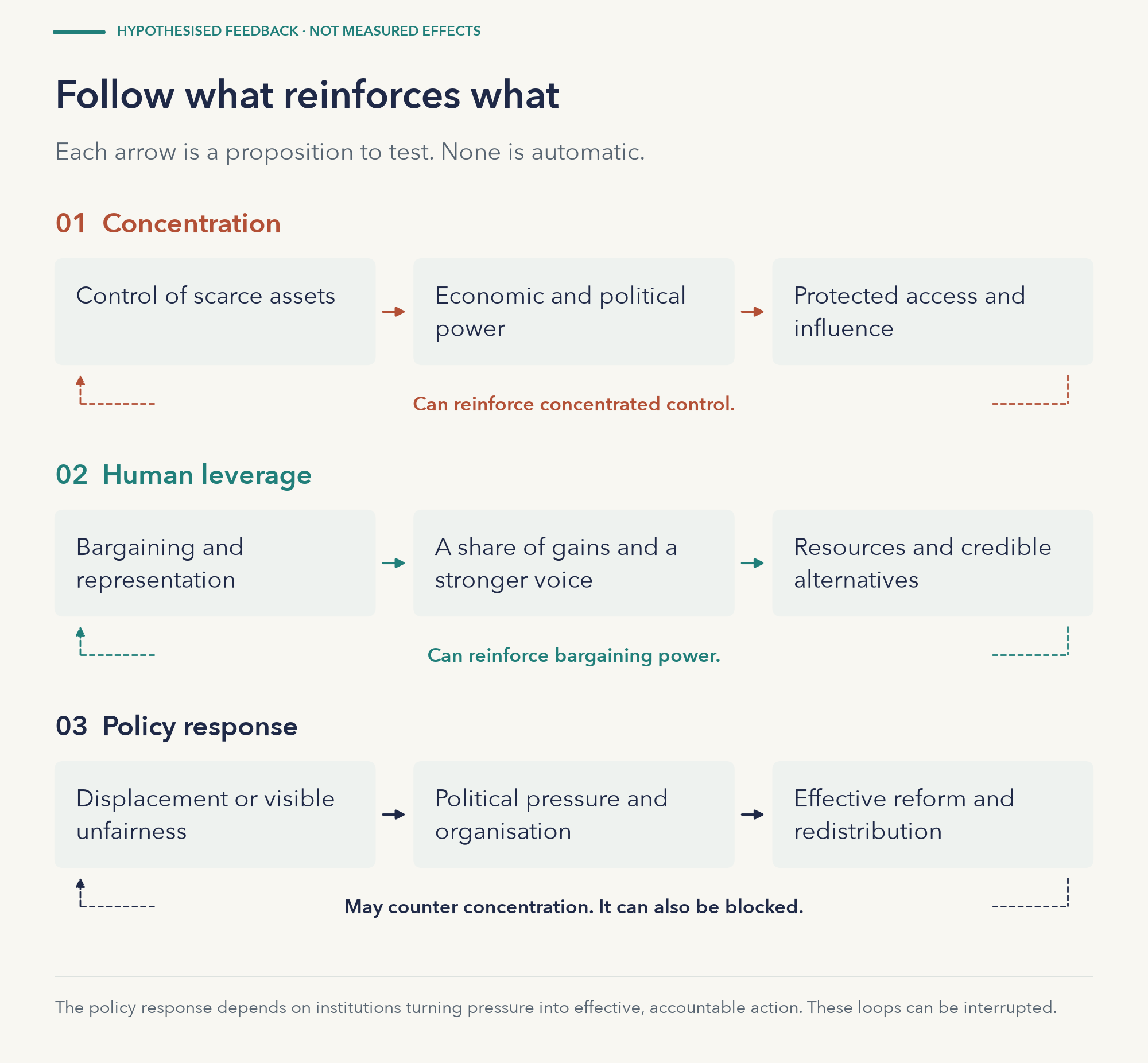
Political backlash offers a possible counter-force, but the sequence ‘people suffer, therefore policy fixes it’ has a rather large missing step. Grievance may produce useful reform. It may also produce paralysis, scapegoating or measures that reinforce the people already in control.
The useful question is where an intervention changes the mechanism. Competition and portability can reduce dependence on a supplier. Worker representation can affect how productivity gains are allocated. Public investment can attach conditions to public support. Broad ownership can connect more households to returns. Independent scrutiny can make it harder to exercise power without explanation.
These are different jobs. Giving everyone a chatbot does not perform all of them.
War does not make the ownership problem simpler
Conflict belongs in the analysis because AI rests on internationally connected physical systems. Chip supply, energy, shipping, finance and access to markets can all be disrupted.

I include renewed US–Iran fighting, new US strikes in Latin America, a Taiwan blockade or invasion, and direct Russia–NATO conflict in the scenarios. The implications differ. An energy shock can raise costs and weaken demand. A disruption to semiconductor supply can make existing hardware more valuable while damaging the businesses that depend on expansion. Governments may impose tighter controls in the name of security.
That lever has already been pulled. Anthropic says a US export-control directive on 12 June 2026 prohibited access to Fable 5 and Mythos 5 by foreign nationals, including those inside the US. The company suspended both models for all users because it could not reliably verify nationality immediately. The controls were lifted on 30 June; general Fable access resumed on 1 July, while some US organisations regained Mythos access earlier. Anthropic's suspension statement, its restoration account.
This was a national-security intervention, not evidence that war caused the shutdown. It shows that the state can change practical access while the provider remains privately owned. That is A3 in action, with an A6 question attached: what evidence, process and route of challenge govern that power?
None of that makes the owner of a scarce asset immune to losses. A destroyed supply chain is not a particularly elegant moat.
My working estimate puts the chance of a Taiwan blockade or invasion, or a direct Russian attack on a NATO country, at roughly one in six by April 2028. That is a subjective judgement, not an actuarial estimate. These events can overlap, and their probabilities cannot simply be added. The components and aggregation caveat are in the conflict note below. I would use the figure to remind myself that the risk belongs in the analysis, rather than to suggest the future has been measured accurately enough to warrant a decimal place.
I would also resist the claim that war necessarily means nobody shares. Emergency powers can concentrate control, but political responses can include price controls, windfall measures, rationing or new social bargains. Which response occurs depends on the institutions and the conflict.
War increases uncertainty. It does not entitle the forecast to become more certain merely because the story has become darker.
Super is the practical ownership route, with limits
For many Australians, superannuation is the most realistic existing route into ownership of AI companies and the infrastructure they depend on. It already pools retirement savings, buys productive assets and allocates investment returns to members. It does not require Washington to agree to an Australian AI-profit levy first.
AustralianSuper, for example, committed US$1.5 billion to US data-centre operator DataBank in 2024. That was AustralianSuper's portion of a roughly US$2 billion equity raise. The fund's own announcement describes its commitment as about A$2.2 billion. This is a concrete example of retirement savings participating in digital infrastructure, rather than a promise that every fund or every member has the same exposure. DataBank's breakdown, AustralianSuper's announcement.

This is why super sits ahead of a hypothetical new AI-dividend scheme in my near-term thinking. It has assets, administrators and beneficiaries already. That is a substantial practical advantage, though it does not make it a complete answer.
Balances differ. Investment choices differ. A person with little accumulated capital receives less benefit from an increase in asset values. Retirement savings also cannot ordinarily pay today's rent after a job loss. And exposure to an industry includes exposure to its losses. ASIC's Moneysmart explanation of super investment options.
I would be wary of turning ‘understand what you own’ into ‘chase the AI boom’. Concentration risk does not disappear because the concentrated investment is fashionable. Diversification is intended to reduce the effect of individual investments performing badly. Moneysmart on diversification.
The useful personal task is to understand your fund's holdings, fees, risk and investment approach. The useful public task is wider: decide how ownership, wages, services and support should work together.
Super is the bridge I would take most seriously because Australians are already using it. We still need to ask who cannot reach it, whose share is too small, and how people live while they wait for retirement.
What would make me change my mind?
My working forecast is 89%: by April 2028, a small group of companies controls a larger share of AI's essential infrastructure and platforms than it does in October 2026, and neither the US nor Australia has established a new, broad public mechanism for sharing AI profits.
By a public sharing mechanism, I mean a funded, enforceable claim for ordinary citizens, such as an AI dividend or broadly shared public ownership fund. Existing company taxes, private shareholdings and super accounts are not the new mechanism being forecast here.
The 89% is my subjective confidence in those two conditions holding together, not a separately measured probability for each one. I intend it as a strong working judgement, not precision to one percentage point. The scenario chart records how that same judgement changes under different assumptions. It is not a validated statistical model.
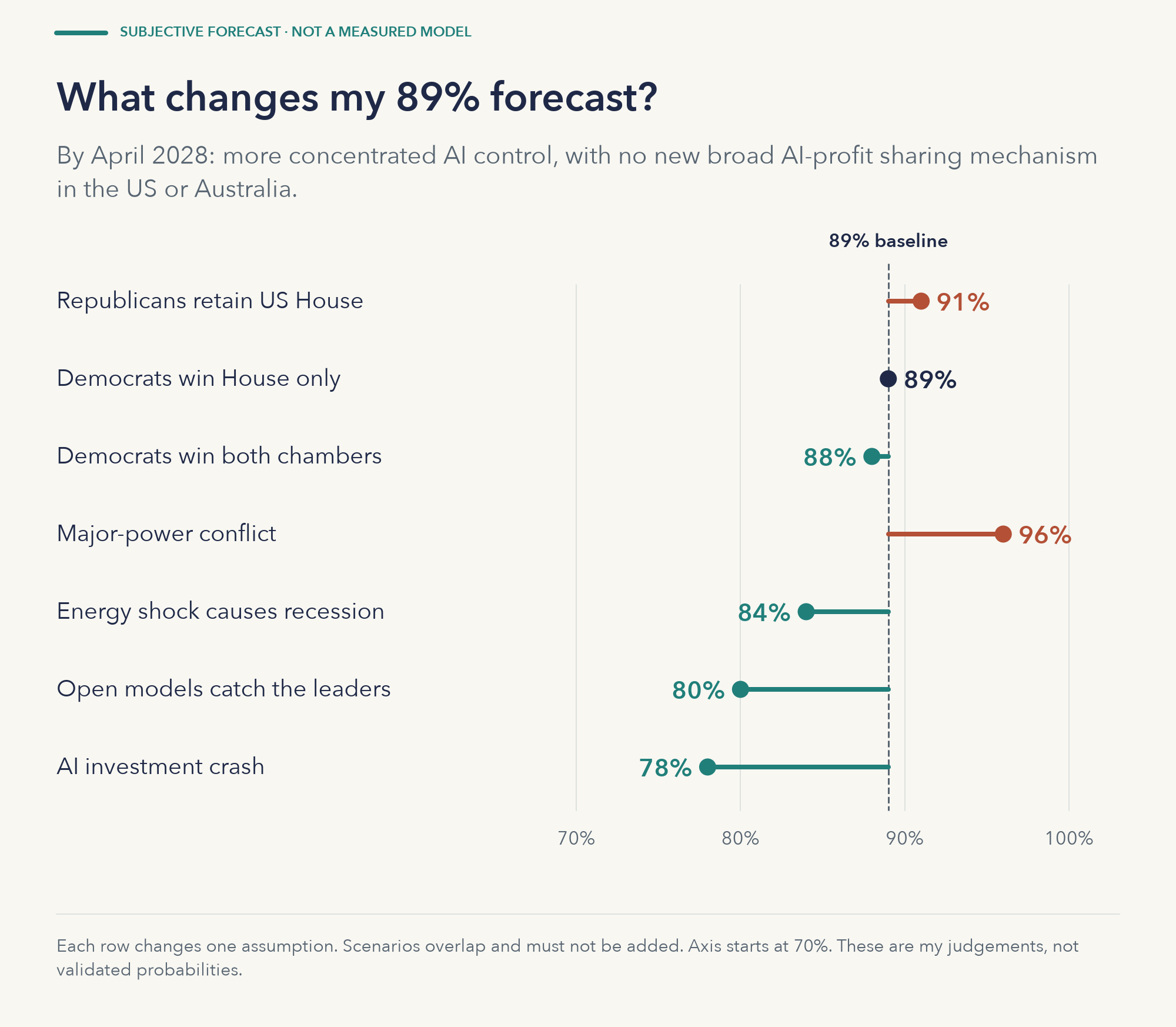
I would reduce my confidence in the concentration story if cheap, portable models gave organisations credible alternatives on real work, and if dependence on the infrastructure and distribution underneath them also fell. A benchmark victory alone would not be enough. The open-weight evidence is a reason to watch this closely. I would look for falling switching costs across the whole service, broader ownership and durable competition, rather than treat token share as a proxy for all three. The 2027 outlook does not independently validate my 89% judgement.
I would change my view on public distribution if a government created an enforceable claim, funded it and started delivering it. A speech would be a signpost. Payments or services reaching people under durable rules would be stronger evidence.
I would become more optimistic about workers if productivity gains showed up in pay, hours, conditions and durable training routes, rather than mainly in headcount targets. I would become more worried if entry-level opportunities contracted while the expectation of experienced judgement remained unchanged.
An investment crash could change the picture, but even that has two directions. It might break the dominance of current owners, or let the best-funded survivors buy distressed assets cheaply. A falling share price does not necessarily distribute control.
And I would watch actual policy and bargaining outcomes after elections. A change in parliament or Congress can matter for budgets, scrutiny, regulation and alliances. Predicting little immediate change in AI ownership is not the same as saying the election does not matter.
The point of the six axes is to make those updates possible. If capability accelerates while distribution improves and accountability strengthens, the conclusion should change. If capability disappoints while ownership becomes more concentrated, the conclusion should change differently.
There is no prize for defending a forecast after its reasons have expired. Apart from, apparently, a recurring television appearance.
The practical question at the next meeting
Most of us will not negotiate the ownership of a frontier AI laboratory this week. There are still decisions within reach.
If you lead a team, make the allocation of productivity gains explicit. What will improve for customers and staff? What happens to training? Which decisions remain accountable to a person? How will you notice if the promised savings have become unpaid checking work?
If you design or buy systems, examine dependence as carefully as capability. Can you move the data, switch the model, retain the knowledge and continue operating if the commercial terms change? Can you also move the permissions, tool connections and work history that make the service useful? Who can withdraw an agent's authority when something goes wrong? A cheaper tool can still create a more expensive dependency.
If you work in policy, ask for the route between public investment and public benefit. Identify the rights, the funding, the delivery mechanism and the evidence that it works. ‘Innovation’ is a useful activity, but an incomplete answer to who receives the return.
And if you are trying to understand your own position, look at both sides of it: what your work depends on and what you own. Learning to use the tools may improve your options. It cannot, by itself, resolve a distribution problem that sits across an economy.
I remain interested in what AI makes possible. More people being able to build, understand, communicate and solve difficult problems is worth wanting.
I would also like the people doing the adapting to have a meaningful claim on the result.
So the next time someone tells us AI will create enormous value, I think the useful follow-up is quite ordinary:
Who gets it, through what mechanism, and what say do the rest of us have?
That question should age rather better than the milk.
Research note: evidence and forecasts are dated 14 October 2026. Linked sources distinguish measured statistics, company announcements and reporting. Forecasts, scenarios and causal diagrams are judgements. Charts show selected historical snapshots, with scope and measurement qualifications beside them. Visuals, the South Korea discussion and the enterprise adoption analysis were revised on 15 October 2026; the capability chart uses METR's published Time Horizon 1.1 data retrieved that day. The accompanying Power Shift Explorer provides the six-axis reference and interactive conceptual views. Illustrations are AI-generated editorial metaphors. Discussion of super and ownership is general information, not a recommendation to buy particular investments.